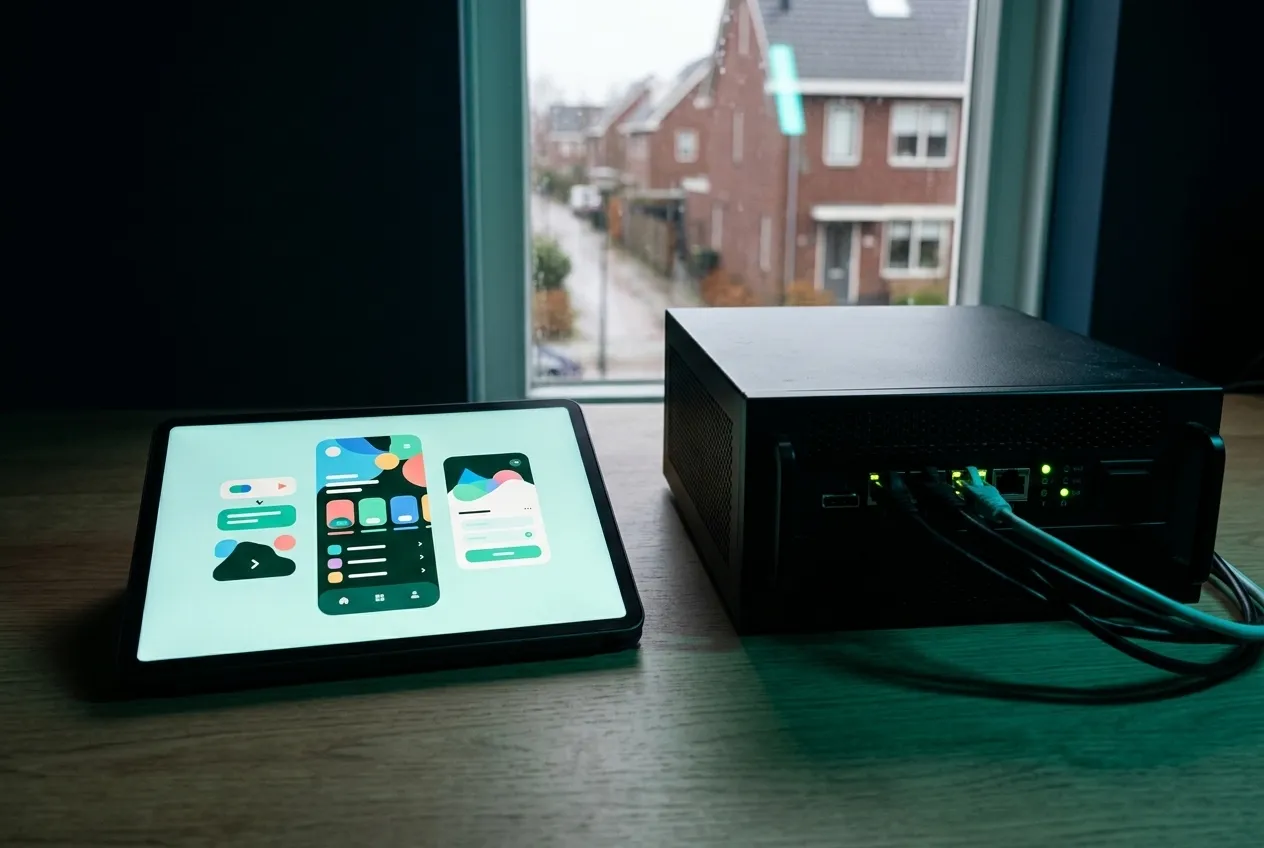
With frontend you check the code without knowing it
A vibe coder doesn’t look at the code. But with frontend, they do look at the result. And that’s the crucial difference: frontend code maps almost one-to-one to the visual. A button in the wrong place, spacing that’s off, a form that looks weird. By inspecting the result, you’re indirectly inspecting the code.
Everyone has an opinion about design. Everyone can look at something. All code is only there to generate that output. You can say “I don’t look at the code”, but you do look at the output.
That makes frontend uniquely suited for vibe coding. You have a direct feedback loop: you make a change, you see the result, you adjust. Even if you don’t read a single line of code, you’re still doing a form of quality control through the visual layer.
Take Tailwind as an example: every page is standalone. You can experiment, make mistakes and start over without affecting the rest of your application. And because every visual error is immediately visible, you catch most problems by simply looking at your screen.
With backend that indirect check doesn’t exist
Backend is by definition invisible. There’s no visual result to inspect. You only have an endpoint, a response, a side effect. And the dangerous thing: the output can look completely correct while the underlying logic is wrong.
With frontend, if you make a mistake in that page, it has zero implications for what follows. With backend it’s different. There’s often business logic there. If something is wrong there, you immediately have pretty big problems.
There's no visual proxy
With frontend, the visual result is a direct reflection of the code. With backend there's no equivalent. You can't see if your authentication works correctly by looking at it.
Errors are latent
A bug in your backend can go unnoticed for months, until someone does a specific action and everything breaks.
Business logic is critical
Backend often contains your company's rules. If something is wrong there, you make wrong decisions based on wrong data.
Security is invisible
You don't see if you have SQL injections or if your API keys are leaking. No visual signal warns you, until it's too late.
The more complex the frontend, the less the visual check suffices
The visual check works perfectly for styling: adjusting a colour in Tailwind, tweaking a margin, fixing a layout. That’s one-to-one visual work. But not all frontend is styling.
If you’re really building fairly large web applications, at some point you run into the problem that your architecture also needs to be good. And that’s not something you see.
As soon as you build a design system with shared components, add form validation or need state management, frontend shifts towards invisible logic. A validation rule that works in one form but not in another, you won’t see by looking at your screen. A component that works on page A but breaks on page B due to shared state, same thing. The more your frontend starts to resemble backend (shared logic, reusable abstractions, complex flows) the less the visual result tells you about the quality of your code.
Where the visual check is enough
Static websites
Like our own website. Markdown files, no database. The result is the only thing that matters, and you can fully assess it visually.
Landing pages
One-time pages that no one ever looks at again. If it looks good, the code is good enough.
Prototypes
Quickly throwing something on the screen to test if an idea works. The visual output is exactly what you want to validate.
Design iterations
Tweaking how something looks is by definition visual work. That's fine to vibe code.
Where no visual check is possible
Authentication and authorization
You don't see if someone can access data they shouldn't see. There's no visual signal to warn you.
Payment logic
You don't see if the calculation is correct until you charge or pay out wrong amounts.
Data transformations
You don't see if your data is getting corrupted until your reports don't match.
State machines
Complex flows with multiple states. The output can look correct while the underlying state is wrong.
Conclusion: the more visual the work, the better vibe coding works
I have to be honest, with frontend things I’m somewhat less critical generally. But for example the backend, I really looked at that. And then I saw at some point that it was just going wrong.
It’s not a simple frontend-vs-backend dividing line. It’s about how much of your code you can indirectly check by looking at the result. The closer your work is to the visual, the more effective vibe coding is. The more invisible logic is involved, the riskier it gets. That invisible layer - auth, payments, data transformations - is exactly what you want to have audited before you go to production.
Purely visual work: vibe coding works
Styling, layouts, landing pages, prototypes. The visual result is a direct reflection of the code. Errors are visible and isolated.
Invisible logic: vibe coding fails
Design systems, validation, state management, business logic, security. The output can look correct while the underlying code is wrong.
Also choose your stack based on how you’re going to work. If you’re going to vibe code, choose tools where the output is directly visible: static sites, serverless functions, as little invisible logic as possible. Our own website is built with Astro and markdown files, precisely because the result is the only thing that matters there.
Need help with your backend?
We help teams that have a vibe-coded frontend but are struggling with the backend. From architecture advice to hands-on development.